
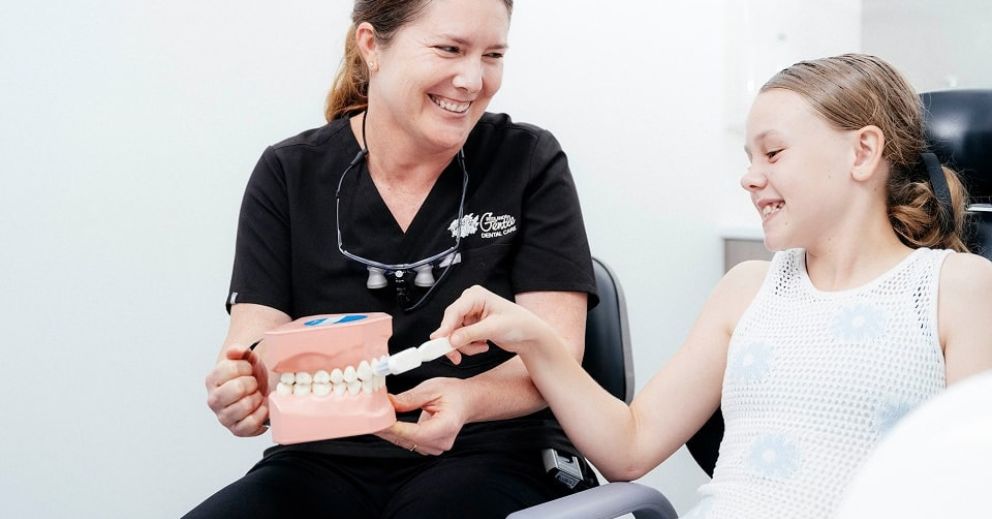
What to Expect at Your First Dental Visit
Will it hurt? Will you tell me off? Those are the two questions new patients ask us most, and they often ask them before they have even sat down. The honest answers are that a first visit is mostly talking, looking and cleaning, and that nobody here is keeping score of how long it has been.
This guide walks through what happens in the chair, what is normal, and what to bring, so the unknown part gets a lot smaller.
Who books a first visit, and why it can feel so hard
We see all sorts of people at a new patient appointment. Some have just moved to the Redlands and need a dentist. Some have left their old practice and want a fresh set of eyes. Plenty have not been in five or ten years, and a good number are finally booking because something has started to nag: a tooth that zings with cold water, gums that bleed when they brush, a chipped edge catching the tongue.
The nerves are real and physical. A dry mouth, a tight stomach, an appointment rescheduled twice. In our experience the dread is rarely about the dentistry itself. It is usually about three unknowns: what we will find, whether you will be judged, and what it will cost. We can deal with all three before we touch a single tooth.
What actually happens, step by step
Every practice runs a little differently, but a new patient check-up with us follows a familiar order. Healthdirect, the Australian Government health information service, describes a standard check-up as a health history, an examination, X-rays where needed, and preventative care such as fluoride and polishing. Here is how that looks in practice.
A conversation before anyone picks up an instrument
We start by asking about your health, not just your teeth. Medications, allergies, medical conditions, whether you smoke, how often you snack or sip sugary drinks, and what brought you in. Some answers that seem unrelated matter more than you might expect. Diabetes, for example, makes gum problems more likely, so it is worth mentioning even if it feels like a separate issue.
This is also the moment to tell us about anything that frightens you. Say it plainly. We would rather know, because it changes how we run the appointment.
The examination
Next comes the check itself. We look at each tooth for decay (softened spots or holes caused by acid from bacteria), cracks, worn surfaces and the condition of old fillings. We check your bite and whether your jaw joints click or tire easily. We also look over the soft tissues, meaning the tongue, cheeks, palate and floor of the mouth, for anything that looks unusual.
The gum check often surprises people. We use a fine, marked probe to measure the small gap between each tooth and the gum, called a pocket. Shallow pockets generally point to healthy gums, while deeper ones can suggest gum disease. A little bleeding at this step is information, not a sign that we have hurt you or that you have done something wrong.
X-rays
X-rays may be recommended when they are needed to check areas we cannot see directly, such as between teeth, beneath fillings or below the gum line. The most common type is a bitewing, where you bite gently on a small tab so we can see the crowns of your upper and lower back teeth together. Australia’s radiation regulator, ARPANSA, describes the standard dental X-ray as a very low dose procedure.
There is a caveat. Not everyone needs X-rays at a first visit. If you have recent ones from a previous dentist, tell us who that was, because we may be able to request them rather than repeat them.
The clean
Then comes the clean. Scaling removes plaque (the sticky bacterial film on your teeth) and calculus, the hardened deposit often called tartar that a toothbrush cannot shift. Polishing smooths the surfaces so plaque has a harder time clinging on, and a fluoride application often follows to help strengthen enamel.
Expect scraping sounds, some vibration and a bit of water. It should not be painful, although sensitive teeth or inflamed gums may feel uncomfortable. If anything hurts, raise your hand so we can pause. Early gum inflammation (gingivitis) is common and, according to Healthdirect, can normally be reversed because it has not yet damaged the teeth or the bone around them.
Sometimes a heavy build up is better spread across two visits, so that your first appointment stays comfortable rather than rushed.
The plan
Finally, we sit you up and explain what we found in plain language. We sort the findings into three groups: things that need attention soon, things we would like to keep an eye on, and things that are fine. You should leave knowing the options and the costs, so you can decide with the full picture rather than feeling pushed.
What a first visit is often mistaken for
It is not a treatment session. A check and clean is mainly about finding out where you stand. If we spot a cavity, the filling is usually booked as a separate visit, which gives us time to do that work properly.
It is not a telling off. People often arrive braced for a lecture about flossing. What we are after is what is realistic for you, whether that is a small change to how you brush or a plan for a mouth that needs more work.
It is not the right slot for an emergency. If you are in significant pain, tell us when you book. A routine check and clean is not designed to treat an abscess or a broken tooth, and we would rather see you sooner for the actual problem.
A clean is not gum treatment. If we find established gum disease, a standard clean may not be enough on its own. We will explain the next step rather than pretend otherwise.
When to seek urgent care instead of waiting
Most dental problems can wait for a booked appointment. These cannot:
- Swelling of the face, jaw or neck, especially with a fever or feeling generally unwell.
- Trouble breathing, swallowing or opening your mouth. Call 000 or go to your nearest emergency department straight away.
- Severe toothache that will not settle with pain relief, keeps you awake, or comes with a foul taste or a small bump on the gum, which can point to infection.
- A tooth knocked out or broken in an injury, particularly if you also hit your head.
- Bleeding from the mouth that does not ease with firm pressure.
If it is not an emergency but still cannot wait, call us early in the day and tell the team it is urgent. Please do not hold out for a routine first appointment if any of the above apply to you.
How to prepare
- Tell us you are nervous when you book, not once you are in the chair. It lets the team plan extra time and a calmer pace.
- Bring your health fund card, a list of your medications, and the name of your previous dentist if you have one.
- Eat something light beforehand and brush as normal. There is no need to scrub harder than usual, because we want to see your mouth as it really is.
- Jot down your questions and symptoms, including what sets them off (cold, sweet, chewing). Triggers help us work out what is going on.
- Agree a stop signal, such as a raised hand. Knowing you can pause at any point tends to help more than people expect.
If nerves have kept you away for years, ask us about our sedation options before the day, so you know what is available.
How we look after you: your first visit and what comes after
Think of it in phases. Allow a little extra time for paperwork and questions, and ask the team how long to book for when you call.
Day one. History, examination, X-rays where needed, the clean, fluoride, and a plan you understand.
The next day or two. Teeth can feel sensitive and gums a little tender, especially if they were inflamed. This is common and often settles within a few days. If it does not, or the pain is getting worse, call us.
The following weeks. If fillings or other treatment came out of your plan, we book them in order of priority, with anything causing pain or putting a tooth at risk first. If your gums need more attention, this is when it would begin.
From here on. Regular check-ups keep small problems small. The general guidance is a visit every 6 to 12 months, and we will tell you where you sit in that range. Someone with a history of gum problems needs closer monitoring than someone with a healthy mouth and reliable home care.
Will you need scans, fillings or surgery?
Most first visits do not lead to anything dramatic. The usual outcomes are that we find nothing beyond the need for a clean, or a small number of things to monitor or treat. Surgery is not part of a routine first appointment.
Larger imaging, such as a 3D cone beam scan, is kept for specific questions like planning an implant or assessing a difficult wisdom tooth. It is not part of a general check. If we ever think you need one, we will explain what it is for and why a standard X-ray is not enough.
Occasionally, something we notice in the mouth needs a doctor’s input, such as an ulcer that has not healed. If that happens, we will say so plainly and refer you.
Keeping your mouth healthy, and booking your first visit
Between visits, a few basics do most of the work: brushing twice a day with fluoride toothpaste, cleaning between your teeth daily, and paying attention to how often (not just how much) you snack on sugary or acidic foods. Each exposure gives bacteria another chance to produce acid, so frequency tends to matter more than quantity.
None of it has to be perfect. What matters is a routine you can keep, and a dentist who sees you before a small problem becomes a painful one. The visit itself is the hardest part, and it is usually shorter and calmer than people expect.
If you are ready, book an assessment online at either our Capalaba clinic (Old Cleveland Road) or our Victoria Point clinic (Bunker Road). We open on Saturdays, and you can also call the clinic directly. New patients can ask about our $199 check and clean.
FAQ
Will my first dental visit hurt?
Most of it should not. The examination and clean usually involve pressure, scraping sounds and water rather than pain. Sensitive teeth or inflamed gums can be more uncomfortable, so tell us and we will adjust. If a filling is needed, it is normally done at a later visit under local anaesthetic (a numbing injection).
Is it too late if I have not been for years?
No. We regularly see people who have not been in a decade. Your mouth may need more attention than someone who visits every year, but the first step is the same: an honest look at where things stand.
Do I need X-rays at my first visit?
Often, because they show what we cannot see directly. If you have recent ones from another dentist, bring the details and we will check whether they can be used.
What if I am very anxious?
Tell us when you book, agree a stop signal, and ask about sedation. Being open about it is the single most useful thing you can do, because it lets us slow down and explain each step.
How much will it cost?
Our new patient check and clean is offered at $199, and we explain any further treatment and its cost before you agree to it. If a larger plan is needed, ask about payment plans.
When should my child have a first visit?
We see children as well as adults, and starting before there is a problem tends to make visits easier. A child’s first appointment is usually short and about getting comfortable. Our children’s dentistry page has more detail.


 Unhappy With My Smile
 I Have Missing Teeth
 Unhappy With My Dentures
 My Teeth Are Stained or Discolored
 Considering Teeth Straightening
 I Have A Dental Emergency
 Seeking Smile Improvement
 Help With Dental Anxiety
 General Dentistry
 Cosmetic Dentistry
 Restorative Dentistry
 Dental Implants
 Dental Veneers
 Invisalign
 Emergency Dentist
 Sedation and Sleep Dentistry